


What Is AI Governance—and Why Should HR Care?
Artificial Intelligence (AI) is rapidly transforming how organizations operate, and Human Resources is no exception. From recruiting tools that screen resumes to systems that monitor employee engagement, AI is already shaping key decisions throughout the HR landscape. But with great power comes great responsibility.
That’s where AI governance comes in.
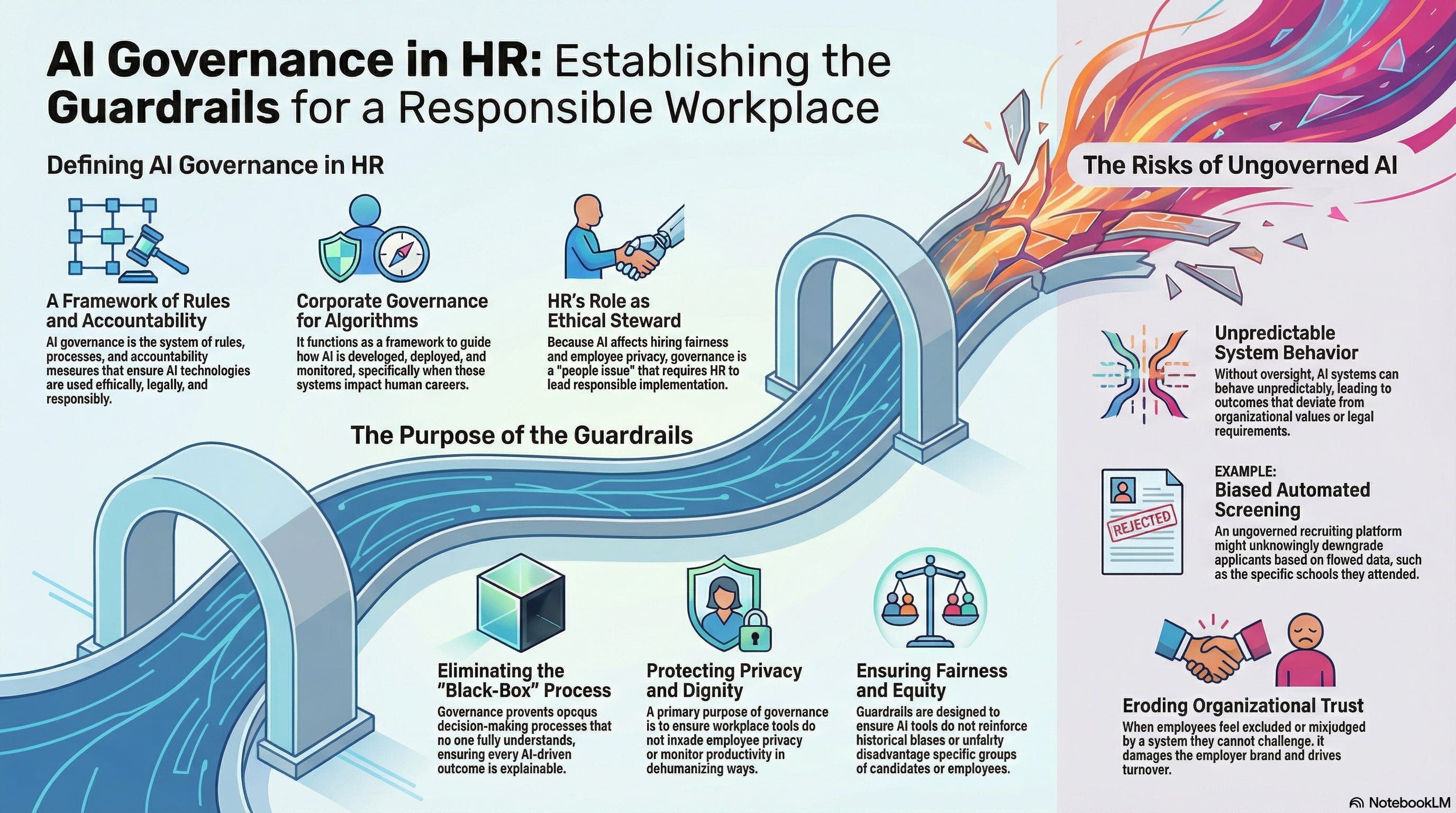
In plain terms, AI governance is the system of rules, processes, and accountability measures that ensure AI technologies are used ethically, legally, and responsibly. It’s about setting guardrails so these tools benefit people rather than harm them.
For HR leaders, this isn’t just a tech issue—it’s a people issue. AI tools can impact hiring fairness, employee privacy, and organizational trust. With new laws on the horizon and heightened scrutiny of algorithmic decision-making, HR professionals are in a critical position to lead the responsible use of AI in the workplace.
Ignoring AI governance could lead to compliance violations, reputational damage, or unintended harm to employees. On the other hand, getting it right means building a more transparent, equitable, and future-ready HR function.
This article outlines five must-know basics for every HR leader on AI governance, including why it matters, what’s changing, and what steps to take next.
1. What Is AI Governance?
AI governance is the framework of policies, practices, and oversight mechanisms that guide how artificial intelligence is developed, deployed, and monitored, especially when it impacts people.
Think of it as corporate governance for algorithms. It’s not just about legal compliance (though that’s important); it’s also about ensuring fairness, transparency, accountability, and ethical use of AI systems. For HR, this means ensuring AI doesn’t reinforce bias, invade privacy, or make opaque decisions that affect people’s careers and livelihoods.
In Plain English:
AI governance helps organizations answer questions like:
Who is responsible when an AI tool makes a bad hiring decision?
How do we ensure the training data used is unbiased and representative?
Can employees opt out of being monitored by AI-driven productivity tools?
Without governance, AI systems can behave unpredictably, amplify inequalities, or create “black-box” decision-making processes that no one fully understands.
HR-Relevant Examples:
A recruiting platform that unknowingly downgrades applicants from specific schools.
An employee surveillance tool that flags “low productivity” based on keyboard activity.
An internal chatbot providing legally risky or outdated HR advice.
These scenarios underscore the need for careful design, implementation, and oversight of AI in HR. Governance ensures these tools serve people—not the other way around.
2. Why AI Governance Matters Now
AI governance is no longer optional—it’s urgent. HR leaders face a perfect storm of regulatory pressure, technological disruption, and human-centered risk. AI tools embedded in hiring, performance management, and employee monitoring systems may promise efficiency, but without oversight, they can also introduce serious problems.
New Laws Are Coming Fast
Governments worldwide are moving quickly to regulate AI use—particularly in high-risk areas such as employment. The EU AI Act, expected to take effect soon, classifies recruitment and workplace AI tools as “high risk,” requiring employers to meet strict transparency, fairness, and accountability standards. Meanwhile, in the U.S., cities such as New York have already enacted laws mandating bias audits for automated employment decision tools.
Failing to comply could lead to fines, lawsuits, or bans on the use of AI-powered solutions altogether.
Automation Is Accelerating
HR teams face mounting pressure to do more with less—especially in high-growth or cost-constrained environments. As a result, AI systems are rapidly being adopted to filter resumes, analyze employee sentiment, or recommend learning pathways.
But speed comes with risk. Without governance, these tools may make decisions based on flawed data or assumptions, leading to discriminatory practices, poor hiring decisions, or reduced employee morale.
The People Process Risk Is Rising
AI governance matters because it protects your most valuable asset: your people. When AI is used in opaque or unfair ways, it erodes trust. Employees may feel surveilled, misjudged, or excluded by systems they don’t understand and can’t challenge.
Missteps in AI use can damage your employer brand, drive turnover, or even trigger legal challenges from candidates or employees who feel wronged by an algorithm.
3. What’s Changing in 2026
2026 is shaping up to be a watershed moment for AI governance—and HR leaders need to be ready.
New Global Regulations Go Live
Several major regulatory frameworks are set to take effect or tighten in 2026.
Notably:
EU AI Act: This landmark law will impose strict requirements on “high-risk” AI systems, including those used for hiring, promotion, and employee evaluation. Companies must conduct risk assessments, ensure transparency, and maintain human oversight over automated decisions.
U.S. and State-Level Laws: Although the U.S. lacks a national AI law, states such as California and Illinois are advancing their own legislation. New York City’s Local Law 144 already mandates bias audits for automated hiring tools, and other jurisdictions are following suit.
These laws are not just red tape—they carry enforcement teeth: audits, fines, and reputational risk.
AI Adoption Hits a New Peak
2026 will also mark a major leap in enterprise AI adoption. Tools powered by generative AI, machine learning, and predictive analytics are expected to be fully integrated into core HR processes, including:
Skills matching and workforce planning
Performance evaluation and feedback analysis
Personalized learning and career development
As these tools become business-critical, the need for proactive governance grows exponentially.
Employee Expectations Are Shifting
Today’s workforce is more tech-savvy and rights-aware than ever. In 2026, expect employees to demand transparency into how AI is used in decisions that affect them.
That includes:
The right to know when AI is involved
The right to contest decisions
The right to opt out of certain monitoring practices
4. HR’s Unique Stake in AI Governance
When it comes to AI governance, HR isn’t just affected—it’s accountable. Few other departments have as much at stake when algorithms intersect with people’s lives, careers, and well-being.
HR Directly Influences “High-Risk” Use Cases
Most AI governance frameworks identify HR-related functions as high-risk applications. The EU AI Act specifically states that high-risk tools include:
Automated resume screening
Video interview analysis
Performance tracking and productivity scoring
Chatbots handling employee relations questions
These tools, if left unchecked, can introduce discrimination, bias, or privacy breaches, all of which fall squarely within HR’s domain.
HR Champions Ethics, Inclusion, and Trust
HR professionals are culture carriers and ethical stewards within the organization. Governance is not a set of rules; it is about aligning AI with company values and human dignity. AI decisions that feel unfair or impersonal can quickly erode employee trust and morale.
That uniquely positions HR to ask critical questions:
Does this tool support our mission and goals?
Have we evaluated the training data for bias?
Do employees understand how AI is being used?
HR Is the Bridge Between Tech and People
Many AI tools are designed and deployed by data teams or vendors—but HR must ensure that human impact is part of the equation. HR leaders can advocate for inclusive design, insist on human-in-the-loop review, and ensure employees have channels to raise concerns.
5. What HR Leaders Should Do Next
AI governance can feel complex, but HR doesn’t need to wait for IT or legal teams to take action. Here are immediate, impactful steps HR leaders can take:
1. Map AI Use in HR
Create an inventory of AI-powered tools used in recruiting, employee engagement, performance management, etc.
2. Ask the Right Questions
Interrogate your vendors: How is the AI trained? What bias-mitigation steps are taken? Is human oversight built in?
3. Collaborate Across Functions
Partner with legal, IT, and compliance to develop governance policies that protect employees and comply with upcoming regulations.
4. Train Your Team
Ensure HR professionals understand the basics of AI systems, risks, and employee rights.
5. Stay Ahead of Policy
Monitor evolving laws in your region—especially those targeting automated employment decisions.
AI governance helps avoid long-term problems, and it’s a chance for HR to lead with clarity, fairness, and integrity as workplaces become more AI-driven. When HR teams stay informed and take the lead, they can help ensure AI tools are used in ways that truly support people at work.
About AI Governance for HR CoLab Workspace
Margaret Spence, author of When AI Breaks the Law, helps HR and talent leaders operationalize AI governance across hiring, performance, and promotion. This CoLab workspace delivers daily frameworks to bridge the gap between compliance documentation and ethical AI principles—the gap where the $365M Mobley lawsuit occurred. You’ll build governance infrastructure that reduces legal, reputational, and EU AI Act compliance exposure before AI-driven talent decisions scale bias into discrimination lawsuits.
Join us live every Wednesday for our Let’s Build Governance Together Series - Our live programs are a premium edition of this Colab.