


Somewhere in Connecticut this morning, an applicant submitted a résumé that may never be read by a person. A ranking placed her below the cut line. A recruiter approved a shortlist she was not on. She will receive a polite rejection or no response at all. She will never know whether a score was involved, what data produced it, or whom to ask.
She did not consent to being evaluated by a system she cannot see. She has no way to correct a record she does not know exists. Every question she might ask belongs to the employer: why, on what basis, and who decided.
Derek Mobley asked those questions. He alleged that employers rejected him for more than 100 jobs using Workday’s screening technology. In 2024, a federal court allowed his claims to proceed on the theory that a vendor can act as an employer’s agent. In May 2025, the court conditionally certified a nationwide age-discrimination collective. The lesson for every HR leader was clear: delegating a decision to software does not delegate responsibility.
Connecticut has now written that lesson into statute. Could You Defend the Decision Tomorrow?
What Connecticut’s New AI Law Actually Changes for Employers
Public Act 26-15, enacted from Senate Bill 5 as An Act Concerning Online Safety, is not only an HR law. It covers automated employment decisions, AI-related layoff reporting, protections for employees of frontier-model developers, AI companions, synthetic-content provenance, and other online-safety matters. Its provisions take effect in phases beginning in 2026.
For HR, the central term is automated employment-related decision technology, or AEDT. Broadly, this refers to technology that processes personal data and produces a ranking, score, recommendation, or classification that is a substantial factor in making or materially influencing an employment-related decision. Covered decisions include recruiting, hiring, promotion, discipline, discharge, renewal, selection for training, and material terms or conditions of work.
The test focuses on the tool’s role, not its technology. Routine software is not covered simply because it performs calculations. A screening score that determines who advances deserves close review. And a recruiter clicking “approve” does not take a tool out of scope if the ranking effectively sets the shortlist. A human signature on a machine decision is still a machine decision.
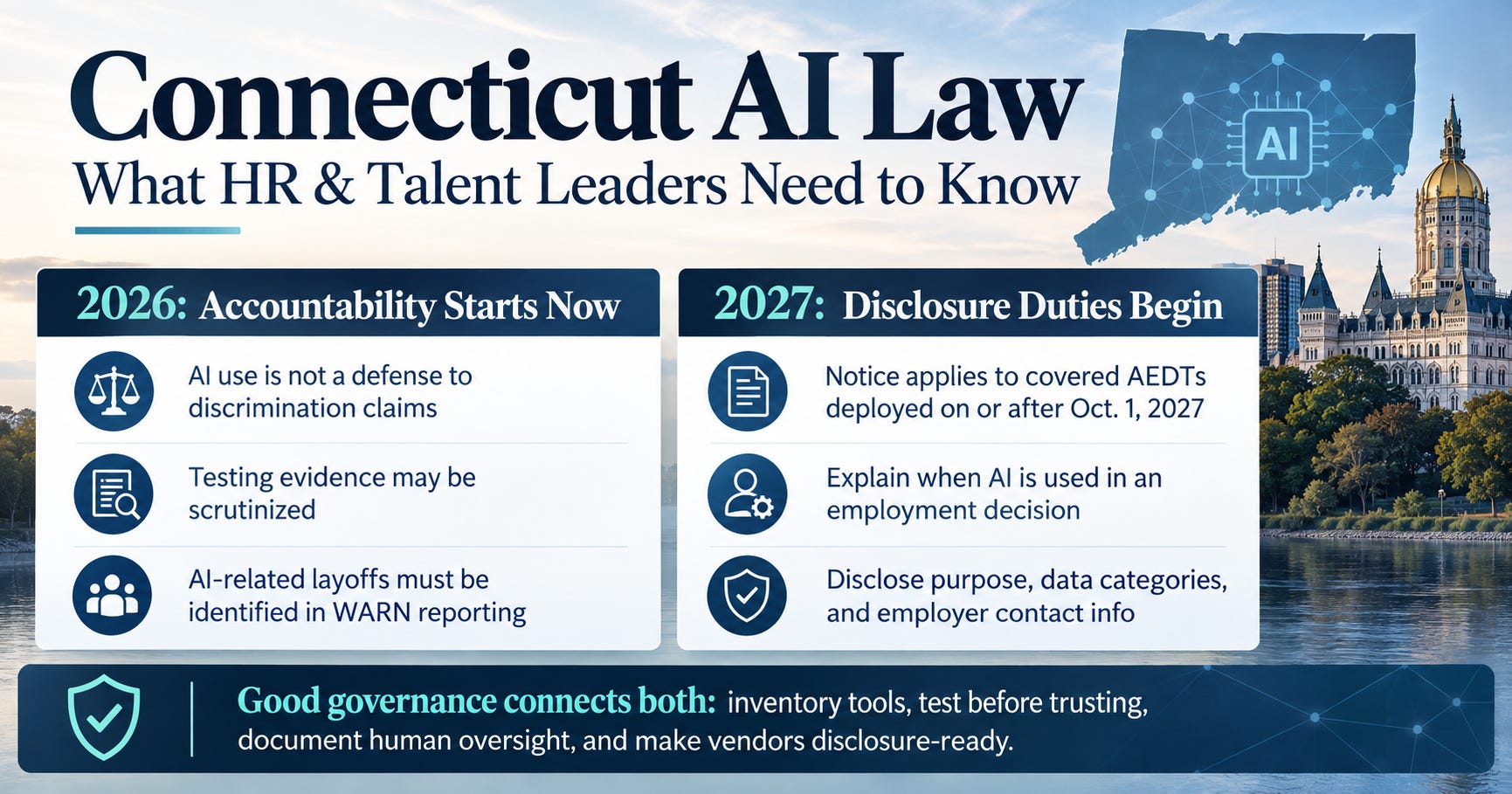
2026: AI Accountability in Human Resources Functions
Two provisions took effect on October 1, 2026.
First, using an AEDT is not a defense to a discrimination complaint. Connecticut’s employment-discrimination law now expressly says so. When a complaint reaches a court or the Commission on Human Rights and Opportunities, either may consider evidence of anti-bias testing or similar proactive efforts. Either may weigh the quality of that testing, its recency, what it found, and how the employer responded.
Those four factors deserve attention because they explain how scrutiny will work. A vendor validation study from three years ago, conducted on someone else’s population, says little about quality or recency in your organization. A disparity found and left unaddressed tells a very different story from one found and corrected. The law looks past whether testing happened to what the employer did with the results.
Precision matters here. PA 26-15 does not require every employer to conduct a Colorado-style impact assessment or a New York City-style annual bias audit. Testing is not mandatory under this act. But once a complaint arrives, the decision-maker will ask for evidence of testing. An employer that never tested does not avoid scrutiny. It faces scrutiny with nothing to show.
Second, AI-related layoffs must be identified. An employer serving a covered federal WARN Act notice must now inform the Connecticut Department of Labor whether the layoffs relate to its use of AI or other technological change, in the form and manner prescribed by the labor commissioner.
This question is broader than most reduction-in-force workflows are designed to answer. It does not only ask whether an algorithm chose which employees to let go. It asks whether AI adoption or automation contributed to the business decision itself. Someone in your organization must answer that question honestly, on the record, before filing. Most organizations have not yet decided who that person is.
Top Three Questions From Connecticut AI Law That Every HR Leader Must Answer:
Which tools influence decisions about who is hired, promoted, trained, disciplined, or separated, and can we explain the process? How does the tool make the decision?
If an applicant challenges an outcome today, what current evidence do we have regarding testing, review, and corrective action?
For every covered tool planned for October 2027 onward, can our vendor provide all the facts needed for an accurate pre-decision notice?
If any answer begins with “I believe” or “the vendor handles that,” the gap is already open. As of today, October 1, 2026, Connecticut has made that gap a legal exposure.
Connecticut's 2026 AI law increases employer accountability for AI-influenced employment decisions and requires AI-related layoffs to be identified in certain WARN reporting. Beginning in 2027, additional disclosure requirements apply to covered automated employment decision technologies deployed on or after October 1, 2027. HR leaders should begin documenting tools, testing, oversight, and vendor information now.
2027: Employers Must Explain the AI Before It Decides
The detailed applicant and employee notice obligations apply to covered AEDTs deployed on or after October 1, 2027.
This timing is easy to misread. Some AEDT sections have a statutory effective date of October 1, 2026, but their operative language imposes duties on technologies deployed on or after October 1, 2027. A compliance tracker listing only the 2026 date will lead employers to believe detailed notices are due today. A tracker listing only 2027 will hide the discrimination and WARN changes already in force. Both mistakes are costly.
For covered deployments, two situations arise. When an AEDT is intended to interact directly with a Connecticut applicant or employee, the employer must disclose in plain language that the person is interacting with the technology, unless that would be obvious to a reasonable person. Before making an employment decision in which the tool plays its statutory role, the employer must give the affected person written notice covering:
that the tool is used, and its purpose
the nature of the decision
the tool’s trade name
the categories and sources of personal data it analyzes
how that data is assessed
the employer’s contact information
Developers who market or supply covered tools must provide employers with the information needed to meet these duties. Contracts may assign specific disclosure obligations, but a vendor agreement does not prove that notice was delivered. Trade-secret protections can shield certain details, but they do not permit saying nothing about the tool or its data use.
The Connecticut attorney general enforces the notice provisions under the state’s unfair trade practices framework. The act does not create a separate private right of action for notice violations. Through the end of 2027, the attorney general may offer a 60-day opportunity to cure qualifying violations. This is discretionary, not guaranteed, and no governance plan should depend on it. Discrimination complaints remain a separate path under existing civil rights law.
Two other dates complete the picture. On January 1, 2027, large frontier-model developers assume internal employee-reporting obligations for specified catastrophic risks. This matters to qualifying AI companies, not to most HR departments that buy software. On July 1, 2027, the state’s independent AI-verification pilot is scheduled to open for applications. Treat verification as possible evidence about a product. It is not state certification and does not provide immunity.

Your AI Compliance Tracker May Be Giving You the Wrong Answer
The tools that need governance most today may be the ones the 2027 notices never reach.
Notice duties attach to tools deployed on or after October 1, 2027. The screening engine you installed in 2024 or the performance-scoring feature added to your talent platform last spring may never trigger a pre-decision notice. Yet each carries the full discrimination exposure that began this morning. How upgrades, redeployments, and material changes will be treated is a question for your counsel. The governance question does not wait for that answer.
That is why the two rules belong together. The 2026 rule asks whether you can defend what the tool did. The 2027 rule asks whether you can describe what the tool will do before it acts. Both require the same underlying knowledge: what the tool is, what data it uses, how it produces its output, how it has been tested, and who is responsible for it. An organization that cannot write an accurate notice cannot credibly defend an outcome, and vice versa.
Good Governance Produces Evidence, Not Policies
Governance in Connecticut must produce records, not intentions. Five practices connect the law to an owner and a document.
Inventory the actual decisions. For each tool, record the name, vendor, version, deployment date, Connecticut population, data inputs, output, and the decision it influences. Include features embedded in applicant-tracking, assessment, performance, and talent platforms. Document the reasoning for every “not covered” determination.
Test before trusting. Evaluate the tool’s performance and potential bias in your own use, not just against the vendor’s general validation. Keep the methodology, dates, population, findings, limitations, and corrective actions.
Make human oversight real. Define who can challenge a score, what evidence they must consider, and when they must escalate or suspend use. Maintain records showing whether reviewers exercised judgment or simply approved the system’s output. This is a governance recommendation, not a separate mandate under Connecticut’s notice provisions.
Make vendors disclosure-ready. Contract for the trade name, intended use, data categories and sources, data assessment methods, testing information, notice of material changes, and cooperation when a complaint arises. Assign responsibility for notice creation and delivery in the contract and in the HR workflow.
Add a layoff decision record today. If a reduction could trigger WARN, document whether AI, automation, or other technological change contributed to the decision. Route that determination through HR, legal, and the business before filing.
One caution. None of this creates a safe harbor. Anti-bias testing does not provide immunity from a discrimination claim, and joining the verification pilot does not certify compliance. Good governance builds evidence and reduces risk. That is its real value, and it should be described as such.
There Is Still a Person on the Other Side of the Score
Go back to the applicant below the cut line. She may never file a complaint. Most people do not. But the law now assumes someone could ask about her outcome, and it asks what your organization can demonstrate.
So, beyond the three questions you started with:
If her rejection were reviewed tomorrow, who in your organization could explain how the tool ranked her, and would that explanation hold up?
When your testing last found something uncomfortable, what changed?
And if your organization’s AI decisions were held to the standard you apply to your employees’ decisions, would you pass?
AI Governance Produces Evidence, Not Intentions
We Track AI Laws, So You Don’t Have To:
The AI Governance Tracker for HR - on Inclusion Learning Lab Website
About AI Governance for HR & CoLab Workspace
Margaret Spence, author of When AI Breaks the Law, helps HR and talent leaders operationalize AI governance across hiring, performance, and promotion. Our CoLab workspace delivers daily frameworks to bridge the gap between compliance documentation and ethical AI principles—the gap where the $365M Mobley lawsuit occurred. You’ll build governance infrastructure that reduces legal, reputational, and EU AI Act compliance exposure before AI-driven talent decisions scale bias into discrimination.