


The typical governance scenario. HR and IT agree on an implementation plan; they build a framework, draft the policy, set draconian guardrails, schedule stakeholder training, and try to deploy governance everywhere at once.
It collapses under its own weight because no one tested it against real-world friction. No one watched what happens when an exhausted recruiter, on a real screening call, must make an immediate judgment about an AI tool they don’t fully trust.
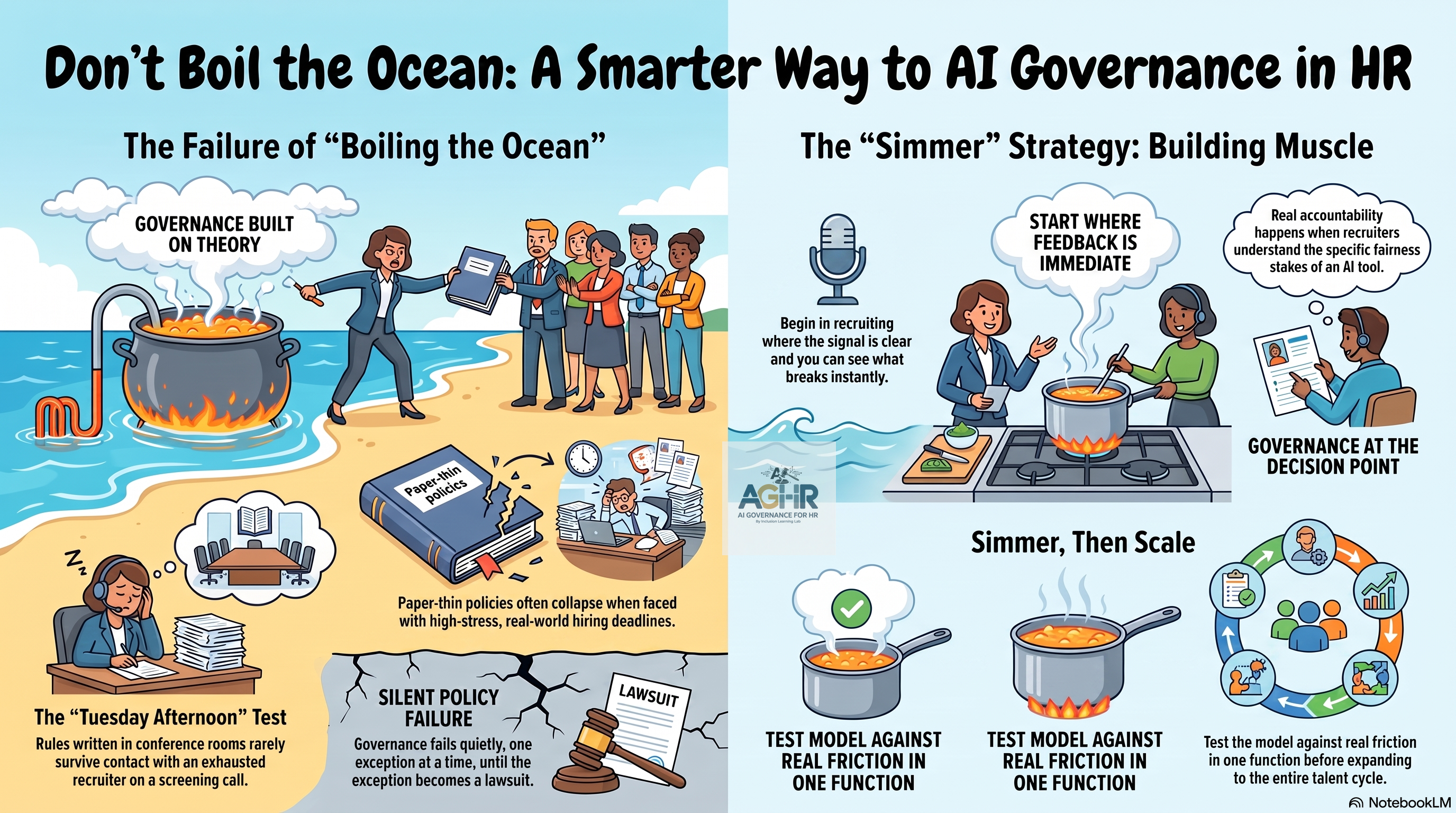
Governance built that way is theory. It looks complete on paper but falls apart when faced with a Tuesday afternoon, high-stress environment. In AI-assisted hiring, so many variables can affect how candidates navigate the hiring process. Governance in the talent cycle is not one-size-fits-all.
Governance that works starts small. It starts with one function, one decision point, and one feedback loop tight enough to spot what breaks. You cannot attempt to implement governance in talent management by boiling the ocean.
AI Governance Best Practice: Start Where the Feedback Is Immediate
Pick the part of the talent cycle where you have the most control and the clearest signal. Run governance there first. Watch it. Then expand.
This isn’t caution for its own sake. It’s how you learn what breaks. You see where people get confused, where they quietly resist, and where a rule you wrote in a conference room doesn’t survive contact with a hiring manager under deadline pressure. You find out what governance looks like when it’s alive, not laminated.
Then, and only then, you scale what you learned.
The AI Governance Muscle Has to Be Built at the Moment of Decision
Every person in the talent cycle—the recruiter screening resumes, the hiring manager reviewing an interview score, the engineer evaluating a candidate’s technical work, the person running onboarding—is making a governance decision about AI, whether or not anyone calls it that. If they don’t understand why that decision matters, governance stays abstract. It becomes a policy. And policies fail, quietly, one exception at a time, until the exception becomes the pattern and the pattern becomes a lawsuit.
So, the real work isn’t writing the framework. It’s making ownership visible and the stakes clear, one person and one decision at a time.
When a recruiter uses an AI screening tool, they need to know three things: What could go wrong here? What am I supposed to catch? What does fairness look like for this specific role, not fairness in the abstract? Once they know that, they own the outcome, not just the process they were told to follow.
The same holds for performance evaluation, promotion decisions, everything downstream in the employee lifecycle. Build the learning so people can trace the line from their specific choice to the larger governance picture their organization is accountable for.
That is the real leverage. Once governance is woven into how people already work, into the moment they’re deciding, it becomes self-sustaining. It’s not a training checkbox completed once and forgotten. It’s a muscle that gets stronger every time it’s used because it’s connected to something the person can see and feel the consequences of.
That’s when accountability sticks. Not because someone memorized a rule, but because they did something that led to a real, visible consequence and they understood why.
Where to Start Testing AI Governance in HR: Recruiting
Recruiting is where the leverage is.
Most organizations are screening thousands of resumes, trying to find genuine talent amid a volume problem. The default solution has been to throw bodies at it. Endless phone screens. The same five questions asked by five different people. The recruiter burns out. The good candidate gets tired of re-explaining their background to the fifth person who never read it and drops out of your pipeline before you ever make them an offer.
Start there. Build the governance framework into the screening process itself, at the point where the AI tool and the human judgment meet.
Every recruiter who runs a candidate through an AI evaluation is making a decision about fairness, bias, what’s actually being measured, and whether it’s the right thing. If they understand why that decision matters and own the outcome instead of just executing the process, that is where the muscle gets built. Not in a training module. In the screening call.
Need to train your team on AI Governance - Learn More Here: https://bit.ly/4f9tTed
The beauty of starting in recruiting is that feedback is immediate. A candidate either advances or doesn’t. You can see, in real time, whether the framework is catching what it’s supposed to catch or whether something or someone is being missed.
Once governance works in recruiting, once you’ve tested it against real friction and real people, the model scales. To performance evaluation. To promotion decisions. To every other function in the talent cycle where an algorithm now sits between a person and a consequence that shapes their working life.
You don’t boil the ocean. You simmer, in one place, until you know exactly what you’re building. Then you carry it forward.
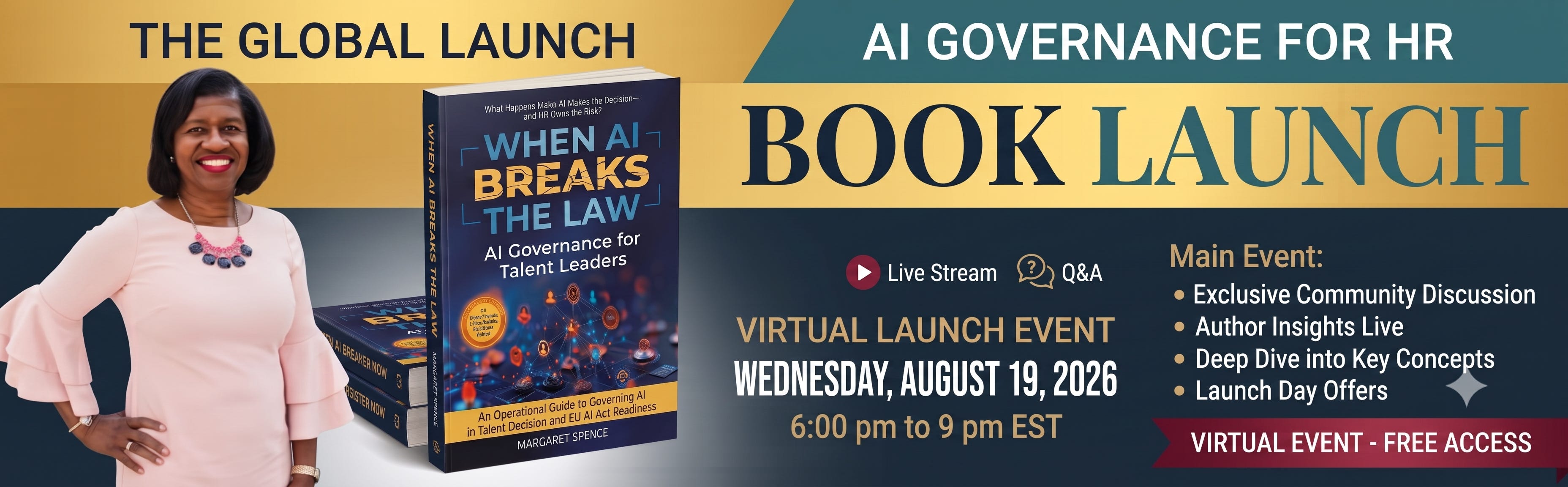
This is the thinking behind When AI Breaks the Law: AI Governance for Talent Leaders, my fourth book and the first AI governance guide built specifically for HR and talent leaders. It’s for the people who sit between the engineers building these systems and the candidates, employees, and executives those systems will judge. The book launches August 19th. If you’re the person who will get the call from General Counsel the morning after an algorithm makes a decision no one can explain, this book ensures you’re not standing there unprepared.
Register for Book Launch: https://bit.ly/4xcxX3k
About AI Governance for HR & CoLab Workspace
Margaret Spence, author of When AI Breaks the Law, helps HR and talent leaders operationalize AI governance across hiring, performance, and promotion. Our CoLab workspace delivers daily frameworks to bridge the gap between compliance documentation and ethical AI principles—the gap where the $365M Mobley lawsuit occurred. You’ll build governance infrastructure that reduces legal, reputational, and EU AI Act compliance exposure before AI-driven talent decisions scale bias into discrimination.
Learn more about our AI Governance Readiness Workshops: https://bit.ly/4f9tTed