


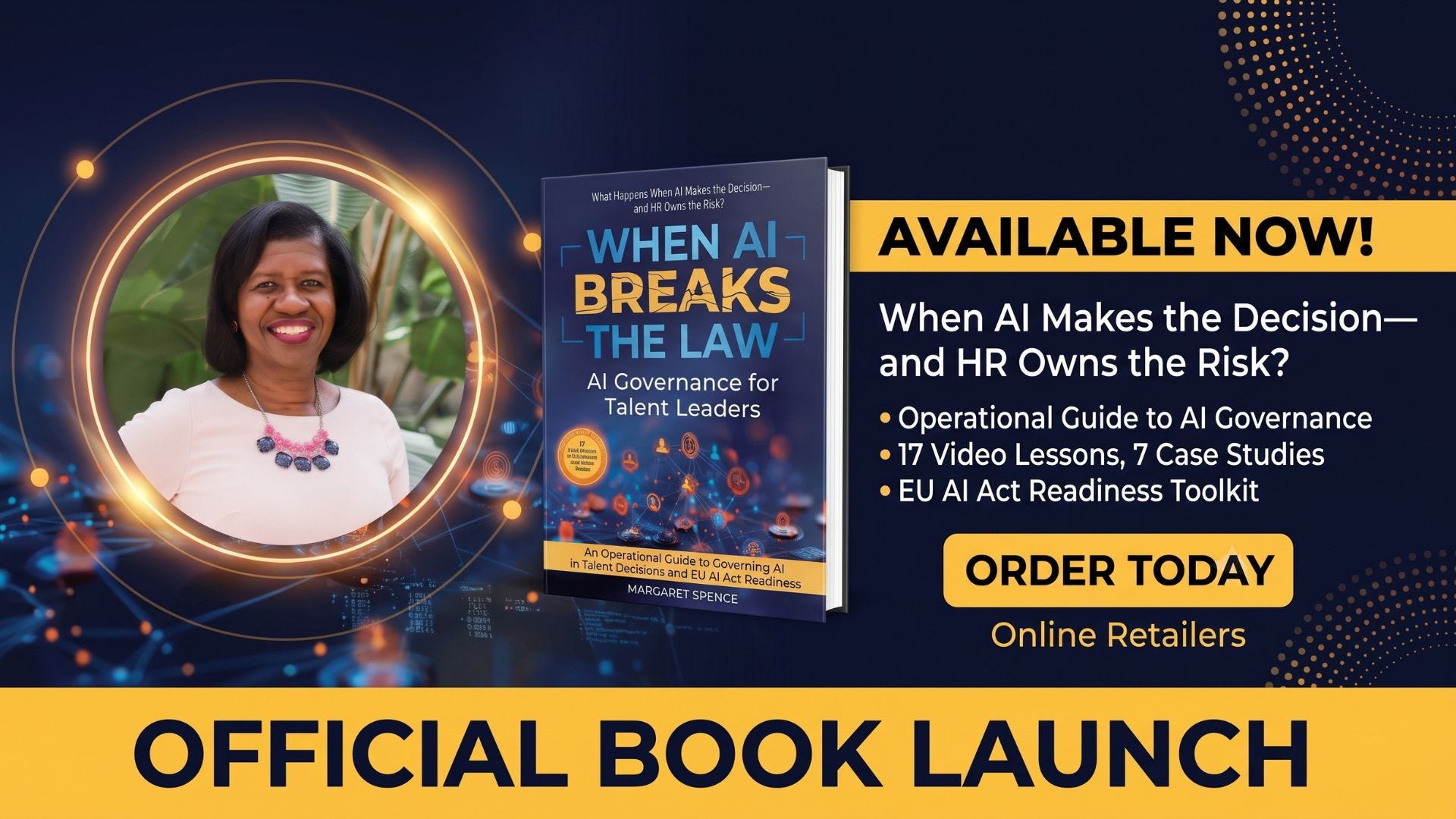
I wrote When AI Breaks the Law: AI Governance for Talent Leaders because I believe HR is standing at one of the most consequential crossroads in our profession.
Artificial intelligence is already embedded in the systems we use to recruit, screen, assess, rank, and make decisions about people. It is not waiting for HR to catch up. It is moving into our organizations now, often faster than our policies, governance structures, and internal controls can keep pace.
That should concern every HR and talent leader.
Not because AI is inherently bad. I am not interested in fearmongering or telling organizations to stop innovating. I believe AI can create tremendous value when used thoughtfully. But I also believe we have reached the point where simply adopting AI is no longer enough.
We have to govern it.
That is why I wrote this book.
The Question I Want Every HR Leader to Ask
There is one question I keep returning to:
Who is actually governing the AI used to make decisions about people?
Think about what is happening inside organizations right now. AI may be helping determine which candidates recruiters see. It may be influencing who gets screened out. It may analyze assessments, recommend talent, support workforce planning, or help managers interpret employee data.
Yet in many organizations, responsibility for those systems is fragmented.
IT may own the technology. Procurement may own the vendor relationship. Legal may review the contract. A business unit may champion the implementation. HR may become involved somewhere along the way.
But who owns the consequences?
That is the part I want HR leaders to rethink.
If an AI-enabled system makes a recommendation that determines whether someone gets access to an employment opportunity, we cannot simply say, “The software did it.”
The employer is still responsible.
The people function remains responsible for protecting the integrity of people decisions.
And HR cannot fulfill that responsibility if we remain on the sidelines of AI governance.
Why I Believe HR Must Be at the Governance Table
I often hear AI governance discussed as if it belongs primarily to technologists, lawyers, or data scientists.
Those professionals absolutely belong in the conversation. Strong AI governance must be cross-functional.
But I believe HR has a unique responsibility because we understand something technology does not: the human context of the decision.
We understand how hiring works. We understand what it means when someone is excluded from consideration. We understand how candidate screening, assessments, promotions, performance decisions, accommodations, and employee relations operate in the real world.
Technology teams may understand how a system functions.
HR must understand how that function affects people.
That difference matters.
When an AI vendor tells us its product can rank candidates more efficiently, I want HR leaders to ask what those rankings are based on. When a tool promises to identify the “best fit,” I want us to ask how it defines “fit.” When a system makes a recommendation, I want us to ask whether a human can challenge it, whether we monitor outcomes, and whether we have enough information to defend the process if someone asks how the decision was made.
Those are not anti-technology questions.
They are leadership questions.
And they are exactly why I believe HR and talent leaders need to read When AI Breaks the Law.
I Wrote This Book Because Good Intentions Are Not Governance.
One of the biggest mistakes I see organizations make is assuming that good intentions will shield them.
They will not.
A company can genuinely believe in fairness and still deploy a poorly governed AI system. A recruiting team can care deeply about candidate experience and still rely on a tool whose outputs have not been adequately challenged. A vendor can describe its technology as responsible even if the employer still lacks the controls needed to use it safely.
Governance requires more than saying, “We care about responsible AI.”
It requires a structure.
Who owns the system? What is it permitted to do? What risks have been identified? What evidence did the vendor provide? How will outcomes be monitored? Who can stop the system if something goes wrong? What documentation are we maintaining?
Those questions need answers before an incident, not after one.
That is why I developed the SimpliFocus AI Governance System and the TRACE AI Mitigation Workflow, both of which I include in the book. My goal was to give HR leaders practical frameworks they can use, rather than broad principles with no roadmap for implementation.
I want readers to finish this book with more than just awareness.
I want them to have a way to act.
This Book Is for Leaders Who Know the Conversation Has Changed
I wrote When AI Breaks the Law for HR and talent leaders who understand that the old way of thinking about HR technology is no longer sufficient.
We are not simply selecting software anymore.
We are selecting systems that can influence consequential decisions about human beings.
That changes our responsibility.
If you are a CHRO, chief people officer, talent acquisition leader, People Operations executive, compliance professional, employment attorney, workforce strategist, or HR technology leader, I want you to enter an AI governance conversation with confidence. When AI Breaks the Law is written for you.
Join the Book Launch Party - August 19th Live on Substack, YouTube, LinkedIn, and Facebook - Register via Zoom (Here) Watch live here on Substack!
Order When AI Breaks the Law and Unlock the Resources to Put It Into Practice
Order the book, and you’ll unlock a library of practical resources designed to help you put the ideas into action. Scan the QR code inside the book or access the book resource page to get started.
17 Video Lessons: Go deeper into the governance issues, cases, laws, and decisions covered in the book.
AI Governance Tools & Frameworks: Practical resources for evaluating risk, asking better questions, and building stronger governance controls.
Case Studies & Implementation Resources: Use real-world scenarios to help your team understand where AI risk actually shows up.
The book explains why AI governance matters. The resources help you start doing the work.
Get When AI Breaks the Law →(Amazon)
The deadline HR teams were working toward has moved. The Commission's implementation timeline now places the Annex III high-risk rules at 2 December 2027 following the Digital Omnibus on AI, with Annex I embedded systems at 2 August 2028. Recruitment and selection tools sit in Annex III point 4, so the Article 26 deployer duties attach on that later date rather than this month. What did start on 2 August 2026 is the Article 50 transparency set, plus enforcement on prohibitions and general-purpose models. The extra sixteen months exist because the harmonised standards are not ready, not because the governance work got smaller.