


Let’s strip away the corporate press releases, the Wall Street restructuring chatter, and the polite Silicon Valley spin.
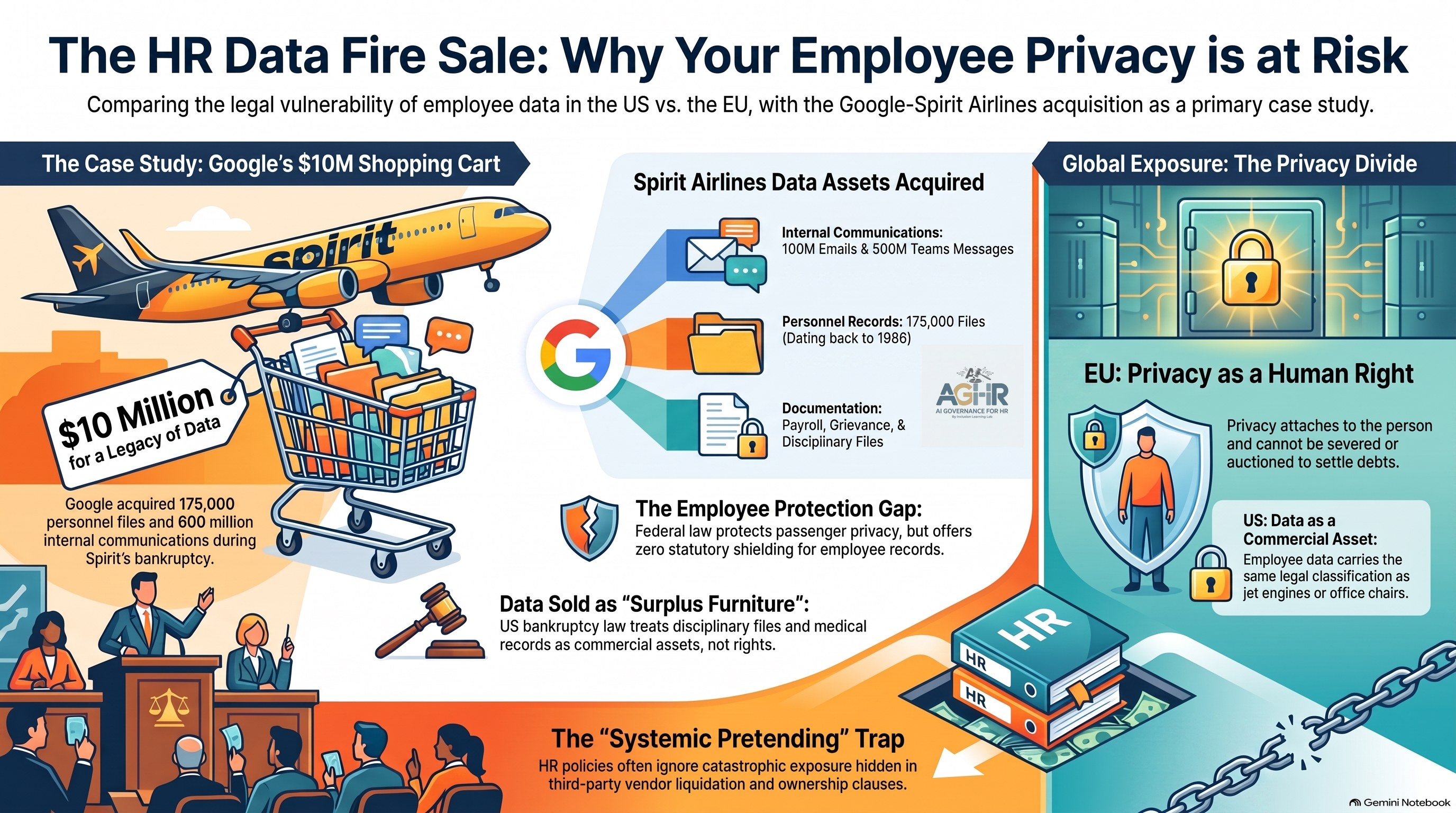
Google just paid $10 million in federal bankruptcy court to acquire Spirit Airlines’ digital infrastructure and corporate data assets. But they weren’t the only company to bid on the data; Micro1 submitted a $12.5 million bid after the bid process closed.
Look at what was inside that shopping cart:
100 million employee emails
500 million internal Microsoft Teams messages
176,000 employee personnel files dating back to 1986
Decades of payroll records, timecards, grievance files, performance reviews, workplace accommodation requests, and internal disciplinary investigations
Every business publication covering this transaction framed it the exact same way: a cloud migration deal, an asset auction, or an infrastructure play to train an AI model.
This is not a tech story.
This is an HR governance crisis, and it is an unvarnished preview of what is waiting inside your organization’s tech stack right now.
The U.S. Privacy Lie: Data Protection is a Right Across the Atlantic, Office Furniture Here
There is an uncomfortable truth that corporate America refuses to say out loud:
In Europe and under international human rights frameworks, privacy is a fundamental right that attaches to the human being. It travels with the employee. It cannot simply be severed, bundled, and auctioned off to settle debts with aircraft leasing syndicates.
Inside the United States, employee data is not a right.
It is a commercial asset.
Under U.S. bankruptcy law, your workforce’s private communications, performance struggles, health accommodations, and disciplinary history carry the exact same legal classification as spare jet engines, unused catering carts, and airport gate leases. When an organization runs out of cash, those records go up for auction and are sold to the highest bidder.
Spirit Airlines’ flight attendant union (AFA-CWA) saw the writing on the wall. They filed a formal objection to the sale in federal court. Why?
Because the bankruptcy court filings went out of their way to ensure that passenger data complied with consumer privacy standards—while offering zero protections for the employees whose entire professional lives were stored in those servers.
Passengers get statutory shielding. Employees get liquidated.
Employee disciplinary files, private chats, and medical records are sold off like surplus office furniture.
The Hypocrisy of Modern HR: Micromanaging Prompts While Handing Over the Vault
Look at where HR leaders and People Operations teams have spent their energy over the last eighteen months.
We have held roundtables. We have drafted 20-page employee handbook policies. We have dispatched urgent memos warning the rank-and-file what not to type into public generative AI:
✖ “Do not paste confidential customer information into ChatGPT.”
✖ “Do not run quarterly strategy documents through Anthropic.”
✖ “Do not summarize internal meetings with unapproved AI note-takers.”
We are aggressively micromanaging employees’ prompts at the keyboard level, while completely ignoring the catastrophic exposure written into our third-party vendor contracts.
We tell ourselves that having an “acceptable use policy” means we have governed AI. It does not. A policy without structural, contractual governance is just paper. I call it Systemic Pretending, nodding along to tech demos and signing software agreements while quietly praying that IT or Legal read the fine print.
They didn’t.
And while you were warning recruiters not to paste resumes into Claude, your HR vendors were structuring business models where your workforce data is worth ten times more than the annual subscription fee you pay them.
The Precedent You Ignored: The Talkspace Warning Shot
If you think the Google–Spirit Airlines deal is an isolated airline bankruptcy anomaly, you haven’t been paying attention to the legal breadcrumbs.
Remember when corporate HR rushed to deploy digital wellness and therapy platforms like Talkspace? They marketed it as modern, progressive benefits design: “Confidential, employer-sponsored mental health support right from your smartphone.”
HR celebrated the rollout. Employees trusted the promise. They poured their deepest workplace anxieties, depression, relationship strain, and burnout into those chat boxes.
Then Universal Health Services (UHS) acquired Talkspace in an $835 million transaction.
What did the acquirer actually buy? They didn’t buy an app interface. They bought billions of data points of raw human vulnerability, one of the world's largest proprietary databases of therapeutic interactions. They absorbed that data to train and benchmark predictive models.

And when employment litigation followed, corporate defense teams and employees alike discovered the devastating legal reality: those verbatim therapy logs weren’t locked away in an untouchable clinical vault. They were commercial vendor records. And under federal discovery rules, they were subpoenaed and produced in open court.
Privacy in HR was never a brick wall.
It was a gentlemen’s agreement.
It was a promise.
And you cannot keep a promise when an algorithmic vendor’s business model depends on harvesting your people.
Coming in Part 2: The Trapdoor Beneath Your Tech Stack
Most HR leaders still believe their biggest AI risk is an employee writing a bad prompt or an algorithm showing subtle bias in candidate screening.
They are looking at the wrong door.
The real crisis isn’t what happens while your vendor is operating smoothly. The crisis is what happens when that vendor fails, pivots, or goes to the highest bidder.
Did you know that 88% of HR tech vendors cap their liability to 12 months of software subscription fees—while leaving your organization completely uninsured for statutory civil damages?
Did you know that major insurance carriers have begun quietly filing AI liability exclusions, leaving employers completely uncovered when autonomous algorithms break employment law?
Do you know what happens to your employee records when your “innovative” ATS or performance platform files for Chapter 11?
You are no longer just software buyers. Without realizing it, you have become unpaid data suppliers for the next generation of enterprise AI foundation models.
In Part 2, we break down:
The New Procurement Trap: Why the software license is just the bait—and your talent database is the actual product.
The Autonomous Agent Risk: What happens when self-directed AI tools execute talent decisions that no human can trace or defend.
The 5 Contract Clauses HR Must Audit This Week: The exact questions you, your General Counsel, and your CISO must demand answers to before your next vendor renewal.
Part 2 drops Saturday morning. If you haven’t audited your vendor contracts, you cannot afford to miss it.
Join the Conversation:
When your organization signs an HR tech contract, who reads the liquidation and data-ownership clauses? Has your team ever asked what happens to your employee data if a vendor is acquired or files Chapter 11? Let’s talk in the comments.
🔔 Subscribe to AI Governance in HR: Ensure Part 2 lands directly in your inbox alongside our weekly breakdowns of AI legal risk and operational governance.
📖 Read the Playbook: Order When AI Breaks the Law: AI Governance for Talent Leaders to build defensible systems before litigation lands on your desk.
Order on Amazon here or Order on IngramSpark here
🛠️ Audit Your Tech Stack: Visit inclusionlearninglab.com to access our AI Governance CoLab, executive briefings, and vendor assessment tools.
This is the thinking behind When AI Breaks the Law: AI Governance for Talent Leaders, my fourth book and the first AI governance guide built specifically for HR and talent leaders. It’s for the people who sit between the engineers building these systems and the candidates, employees, and executives those systems will judge. The book launches August 19th. If you’re the person who will get the call from General Counsel the morning after an algorithm makes a decision no one can explain, this book ensures you’re not standing there unprepared.
Order your copy now on Amazon (Link Here)