


Executive Summary
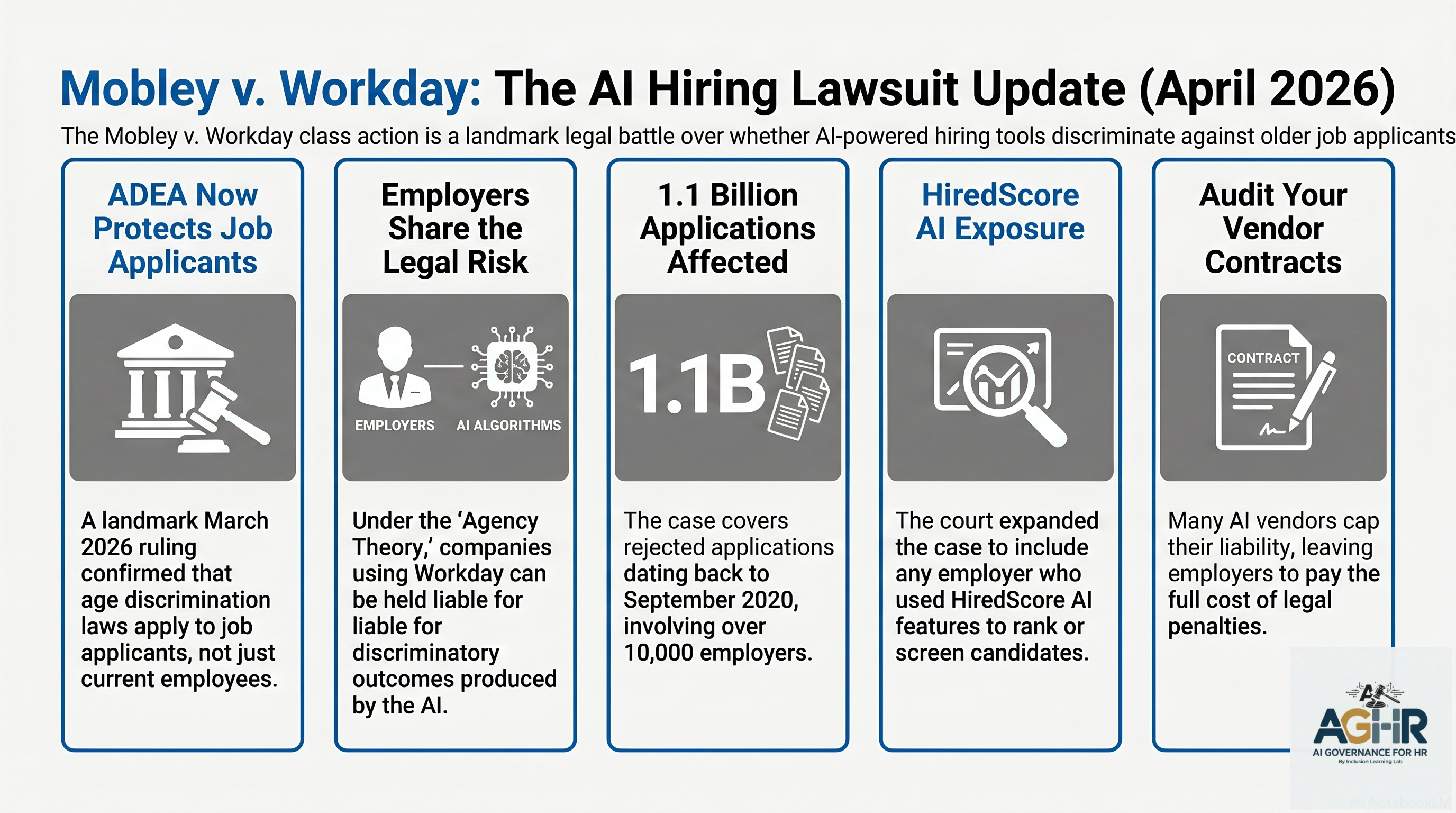
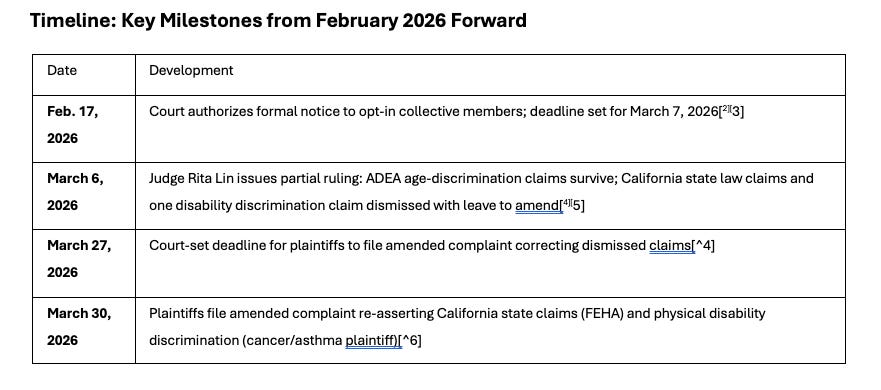
Mobley v. Workday, Inc. (Case No. 3:23-cv-00770-RFL, U.S. District Court, Northern District of California) has accelerated significantly since February 2026. The case has moved from conditional collective certification into active litigation of its legal scope, with a landmark March 6, 2026 ruling rejecting Workday’s strongest remaining dismissal argument — that the Age Discrimination in Employment Act (ADEA) does not cover job applicants. Plaintiffs responded on March 30, 2026, with a new amended complaint that reasserts dismissed California state and disability claims. The case now presents compounding exposure not only for Workday itself, but increasingly for the more than 10,000 employers that use Workday’s AI-powered hiring tools.
The March 6 Mobley Ruling: What Shifted and Why It Matters
Workday’s ADEA Gambit — and Its Failure
In January 2026, Workday escalated its defense by arguing that the ADEA’s disparate-impact protections simply do not apply to job applicants — only to current employees. Workday pointed to en banc rulings in the 7th and 11th U.S. Circuit Courts of Appeals supporting its position. The company further argued that the Supreme Court’s 2024 decision in Loper Bright Enterprises v. Raimondo — which eliminated Chevron deference to federal agency interpretations — should have invalidated the 2017 California district court precedent extending ADEA coverage to applicants.[6][4]
Judge Rita Lin flatly rejected both arguments. She held that Loper Bright did not apply because the 2017 district court decision was not contingent on agency deference — and moreover, that Loper Bright still allowed courts to give weight to agency interpretations under the older Skidmore v. Swift standard. The EEOC’s longstanding interpretation that the ADEA covers job applicants, Lin wrote, was “persuasive” under that standard. This is a significant defeat for Workday’s legal strategy: the company had hoped the new anti-deference climate post-Loper Bright would undercut the plaintiff’s statutory standing. It did not.[5][4][^6]
What Was Dismissed (and Why It May Not Stay Dismissed)
Judge Lin did grant Workday’s motion to dismiss two categories of claims:[^5]
1. California state law claims (FEHA): Dismissed for insufficient factual allegations that Workday’s conduct had sufficient nexus to California.
2. Physical disability claim (cancer/asthma plaintiff): Dismissed because plaintiffs made “no factual allegations” describing how Workday’s products discriminated on the basis of physical disability specifically.[^6]
Both were dismissed with leave to amend — meaning plaintiffs were given the chance to correct the deficiencies. The March 30 amended complaint did exactly that, alleging that: (a) class members were rejected from California-located positions, and that Workday’s tools are “designed, developed, maintained, and controlled” from its California headquarters; and (b) that Workday’s tools incorporated data points — including employment interruptions and patterns consistent with medical leave and treatment — “commonly correlated” with conditions like cancer and asthma. Legal observers note that while Workday technically won these dismissal motions, the re-filed allegations are substantively more detailed, and the dismissal effect is likely temporary.[4][7][^6]
The Opt-In Notice Process: Scale of the Collective
On February 17, 2026, the federal court authorized formal notification to potential class members, with an opt-in deadline of March 7, 2026. The collective — certified in May 2025 — covers:[^2]
“All individuals aged 40 and over who, from September 24, 2020, through the present, applied for job opportunities using Workday, Inc.’s job application platform and were denied employment recommendations.”[^8]
The scale is staggering. Court documents referenced 1.1 billion job applications rejected using Workday’s software during the relevant period. Workday itself has speculated the collective could be “hundreds of millions” of people — a claim the court noted was not a basis for denying notice: “Allegedly widespread discrimination is not a basis for denying notice”. The court’s official case notification website is workdaycase.com.[9][10][^11]
HiredScore: The Expanding Liability Perimeter
One of the most significant pre-February 2026 developments was a July 2025 ruling ordering Workday to disclose a complete list of employers who enabled HiredScore AI features in their hiring process. Workday acquired HiredScore after the original complaint was filed, and argued the product was a “separate product, built on a wholly separate technology platform” that should not fall under the collective’s scope. Judge Lin rejected this.[12][13][^14]
The court expanded the collective definition to include “individuals whose applications were scored, sorted, ranked, or screened using the HiredScore AI features”. Workday was ordered to identify customers who enabled HiredScore AI by August 20, 2025. This ruling matters because HiredScore is Workday’s most advanced AI screening product — used by enterprise clients — and its inclusion dramatically expands both the size of the opt-in pool and the number of employers now on a disclosed list associated with the litigation.[13][14]
New Exposures for Workday Customers: The “Agent” Theory and What It Means for Employers
The foundational legal theory that survived all dismissal motions is the agency theory: that Workday, when performing AI-powered applicant screening, acts as an agent of the employers who contracted for its services. The court has held that an employer cannot “escape liability for discrimination by delegating [] traditional functions, like hiring, to a third party,” and that an employer’s agent can be independently liable when the employer has delegated functions “traditionally exercised by the employer”.[15][16][^17]
This creates a dual-track liability risk. Workday is a defendant as the agent. But employers themselves remain exposed as the principals who delegated hiring functions and benefited from the AI screening. As Foley & Lardner noted in October 2025, “While only Workday is thus far a defendant in Mobley, there is certainly a risk that employers will become defendants in this case or in other actions. Given the ubiquity and growth of AI, many employers are potential defendants”.[18][19][^20]
The Vendor Contract Gap
A critical — and often overlooked — exposure stems from how vendor agreements are structured. Industry data cited in recent legal analysis reveals that 88% of AI vendors cap their own liability, often to monthly subscription fees, while only 17% warrant regulatory compliance. This means Workday’s customers may have signed contracts that:[^21]
· Cap Workday’s financial exposure to nominal subscription fees
· Disclaim any compliance warranties with discrimination law
· Restrict customers’ ability to conduct algorithmic audits[^21]
When an employer is sued — or subpoenaed — for discriminatory hiring outcomes driven by Workday’s AI, the employer may have no meaningful contractual recourse against Workday. The legal and financial risk sits almost entirely with the customer.
The HiredScore List: Customer Exposure by Disclosure
The court-ordered disclosure of which employers enabled HiredScore AI features creates a new layer of reputational and legal exposure. Workday’s client base includes more than 65% of the Fortune 500 and over 70% of the top 50 companies, spanning clients across 175 countries. Being named on a court-disclosed list of HiredScore users — which plaintiffs’ counsel will use to notify potential opt-in plaintiffs — exposes those employers to:[22][23][^24]
· Direct contact from plaintiffs’ attorneys targeting employer co-defendants
· Internal and external scrutiny of their AI hiring practices
· Regulatory attention in states with new AI employment laws[23][1]
The 5-Year Exposure Window in the Mobley v. Workday Case
The collective action window runs from September 24, 2020 through the present — meaning hiring decisions made as far back as late 2020 are now part of the evidentiary pool. As one employment law commentator noted, an employer’s AI may have passed a 2025 audit while producing discriminatory outcomes in 2021–2023, with no contemporaneous monitoring records. “In litigation, that’s not a compliance gap. That’s negligence”.[25][8]
Regulatory Convergence: The Litigation–Regulation Pincer
The Workday case does not exist in a regulatory vacuum. Multiple converging laws are tightening the compliance frame around precisely the conduct at issue:
These laws transform what an emerging litigation risk is into an active compliance obligation. Employers who receive the Mobley opt-in notice — and realize they were not disclosing, auditing, or governing their Workday AI tools — may find themselves simultaneously exposed in litigation and in regulatory enforcement.
The Eightfold AI Case: A Second Front
Commentators now describe a “pincer movement” forming around AI hiring vendors. A major class action filed in January 2026 against Eightfold AI alleges the company operated as a consumer reporting agency — collecting and scoring applicant data from unverified third-party sources without consent — in violation of the Fair Credit Reporting Act. While Workday establishes that the vendor is an agent liable for discrimination, Eightfold frames the vendor as a consumer reporting agency subject to transparency mandates. One case attacks outcomes; the other attacks process. Together, they form a legal framework under which AI hiring vendors face liability from multiple angles simultaneously.[^21]
Other articles about Mobley v. Workday:

What Remains Unresolved in Mobley v. Workday
The case is still in pre-trial/discovery phase. Key open questions include:
1. Discovery into Workday’s algorithms: The upcoming discovery phase will scrutinize the actual logic of both Candidate Skills Match and HiredScore AI features — testing whether Workday’s tools function as “neutral aids” or as decision-makers.[^29]
2. Scope of the amended complaint: Judge Lin has yet to rule on whether the newly filed March 30 amended complaint sufficiently cures the dismissed California/disability claims. If allowed to proceed, the scope of the case expands further.
3. Employer co-defendant risk: Whether employers on the HiredScore disclosure list become named defendants remains the case’s most consequential open question for Workday’s customer base.[^20]
4. Settlement pressure: With a collective potentially in the hundreds of millions of people, the litigation economics may increasingly favor settlement, though no settlement discussions have been publicly reported.
Action Checklist for HR Leaders and Organizations Using AI Hiring Tools
Given the developments above, organizations using Workday or any AI-based applicant screening platform should consider the following immediate steps:
Audit your vendor contracts: Determine what liability cap Workday has imposed, whether any compliance warranties exist, and whether you have audit rights over Workday’s AI systems.
Identify your HiredScore exposure: Determine whether your organization enabled HiredScore AI features after Workday’s acquisition and whether your employees fall within the disclosed list’s scope.
Conduct an adverse impact analysis: Run disparate impact analyses across age (40+), race, and disability status on all applications processed through Workday since September 2020. Gaps in this data are themselves a litigation risk.
Implement human-review checkpoints: Ensure that no hiring decision is fully automated. Meaningful human review of AI-ranked candidates is now both a legal best practice and a specific requirement under the Colorado AI Act.
Update disclosure practices: Notify applicants of AI involvement in screening, as required under California, Illinois, and (by June 30) Colorado law — and as a best practice in all jurisdictions.
Engage employment counsel: The intersection of the Mobley agency theory, the HiredScore disclosures, and new state AI laws creates compounding exposure that requires legal review of current practices.
If you would like to do your own research on the Mobley case, here is the links to the references used in this summary. Again, this is straight from Perplexity. I did little to no editing of the content.
References
1. If Your Company Used Workday to Hire People, It Could Face Legal ... - The widening scope of an age discrimination lawsuit against the hiring platform could ensnare thousa...
2. Federal Court Authorizes Notice in Lawsuit Challenging AI Hiring ... - Federal Court Authorizes Notice in Lawsuit Challenging AI Hiring Software for Potential Age Discrimi...
3. Federal Court Authorizes Notice in Lawsuit Challenging AI Hiring ... - Federal Court Authorizes Notice in Lawsuit Challenging AI Hiring Software for Potential Age Discrimi...
4. Workday takes partial loss as judge refuses to dismiss claims in AI ... - The court rejected the company’s position that federal anti-age discrimination law does not cover jo...
5. Workday AI Lawsuit Explained: Implications for HR - OutSolve - In early March 2026, a federal judge allowed the age discrimination claims under the Age Discriminat...
6. Workday plaintiffs submit amended complaint reupping ... - HR Dive - The filing is a response to a federal judge’s partial dismissal earlier this month with leave to ame...
7. What the Court Actually did in Mobley v. Workday - HRExaminer - Workday moved to dismiss portions of the latest complaint by Mr. Mobley and some additional Plaintif...
8. Workday Case - ... Artificial Intelligence (“AI”) features on its job application platform, violated the Age Discri...
9. The Workday Recruitment Lawsuit: What HR Needs to Know - The case, Mobley v. Workday, has become a critical test for how anti-discrimination laws apply to au...
10. Mobley v. Workday, Inc., 3:23-cv-00770 - Read the full text of Mobley v. Workday, Inc. (Mobley v. Workday, Inc., No. 3:23-cv-00770 (N.D. Cal....
11. Federal Court Authorizes Notice in Lawsuit Challenging AI Hiring ...
12. Judge orders Workday to supply an exhaustive list of employers that ... - Workday cannot narrow the collective to exclude individuals ranked or sorted using the HiredScore ar...
13. USA: Judge orders Workday to provide list of customers who used ... - USA: Judge orders Workday to provide list of customers who used HiredScore AI in their hiring proces...
14. Workday Lawsuit Over AI Hiring Bias (As of July 29, 2025) - July 2025: Mobley vs Workday expands to include acquired AI, HiredScore—raising new questions for ex...
15. VIDEO – DMCAR Trend #9: Artificial Intelligence Impacted The ... - Judge Rita F. Lin granted in part and denied in part Workday’s motion to dismiss the amended complai...
16. California District Court Rules That Software Vendor Is Subject to ... - On July 12, 2024, in a keenly awaited decision, the U.S. District Court for the Northern District of...
17. Mobley v. Workday: Court Holds AI Service Providers Could Be ... - The Court’s decision, issued on July 12, 2024, rejected the theory that Workday, the AI vendor, was ...
18. Mobley v. Workday, Inc. and the Risks of AI Employment Tools - Workday, Inc., a lawsuit filed in a California federal court in 2023 alleging that these AI-based hi...
19. When Artificial Intelligence Discriminates: Employer Compliance in ... - Workday, Inc., a lawsuit filed in a California federal court in 2023 alleging that these AI-based hi...
20. AI Hiring Targeted by Class Action and Proposed Legislation - Very recently, the court ordered Workday to turn over its list of employer clients who used Workday’...
21. AI Hiring Under Fire: Algorithmic Screening Enters The Chat - A major class action lawsuit filed in January 2026 is reshaping the legal landscape around AI-powere...
22. Applied For A Job Through Workday? Court-Authorized Opt-In Is Now Open - A court-authorized opt-in process is now open in the Workday AI hiring lawsuit, raising major questi...
23. The Workday Lawsuit Just Changed Everything: Why Your Hiring ... - Workday to proceed as a nationwide collective action under the Age Discrimination in Employment Act ...
24. Workday Ordered to Disclose Employers Using HiredScore AI - We previously reported on the lawsuit against Workday alleging discrimination by their AI job filter...
25. Workday AI Screening Timeline Exposed 2020-2026 - LinkedIn - September 2020 to present.That’s the exposure window in the Workday class action—5+ years of decisio...
26. Colorado AI Act Official 2026: What SB24-205 Means for ... - Tenzo AI
27. Navigating the AI Employment Landscape in 2026 - K&L Gates - Navigating the AI Employment Landscape in 2026
28. Colorado Postpones Implementation of AI Law as California ... - Seyfarth Synopsis: Colorado has postponed implementation of its landmark AI law until June 2026, fol...
29. Workday’s AI Lawsuit Precedent Could Reshape Vendor Liability ... - The lawsuit’s core allegation is that Workday’s AI screening tools produced illegal disparate impact...