


In Part 1, we exposed the uncomfortable truth behind Google’s $10 million acquisition of Spirit Airlines’ corporate data assets: within the United States, employee records carry no statutory privacy rights in bankruptcy. They are commercial assets sold to the highest bidder under Section 363 of the Bankruptcy Code, alongside spare jet engines and airport gate leases. Google's ability to acquire the entire database from Spirit Airlines' bankruptcy proved this point.
If you thought that was an isolated airline anomaly, look beneath your tech stack.
Look at the economic transformation underway across the HR technology landscape.
SaaS subscription prices are falling, and vendors are bundling them into aggressive enterprise discounts. They are offering talent acquisition, performance management, and employee wellness tools at razor-thin margins.
Why? Because the software license fee isn’t the jackpot anymore.
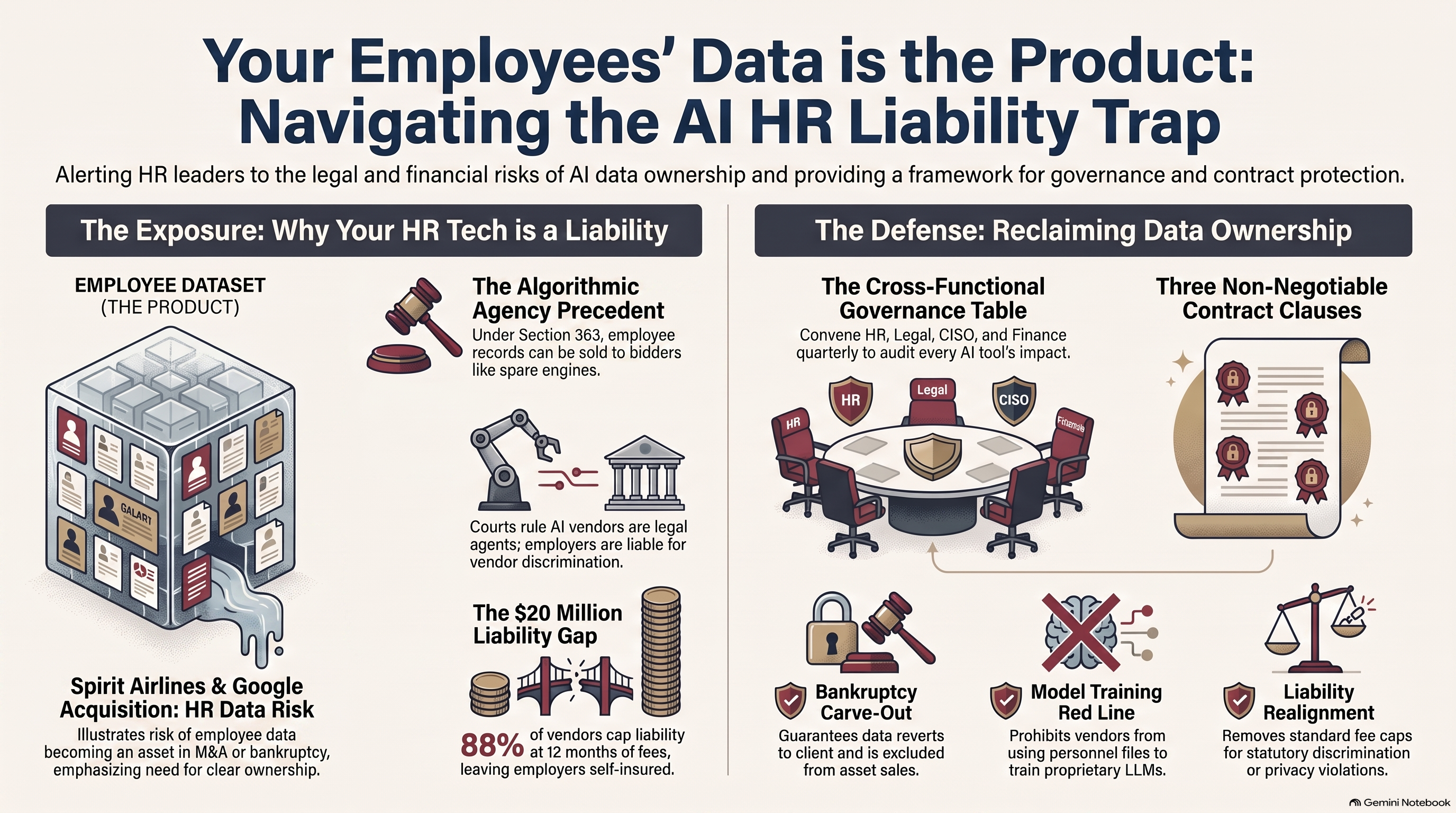
An AI vendor’s true financial value lies in accumulating massive, structured, proprietary datasets on human interaction, performance trajectories, medical accommodations, and disciplinary nuance. They harvest that data to train, fine-tune, and benchmark the next generation of autonomous enterprise agents. Then they turn around and sell those same agents back to you.
Consider what happens when that startup vendor fails to raise its next round of venture capital, files for Chapter 11, or accepts a buyout from a tech conglomerate:
The software application shuts down.
The data does NOT vanish.
It gets packaged, transferred, and absorbed into a data warehouse or foundation model, or weaponized in third-party litigation.
The Legal Breadcrumbs: 4 AI Litigation Cases Every HR Leader Must Know
If you believe an “acceptable use policy” or a vendor certification protects your organization in court, look at the legal precedents quietly reshaping employment law today:
1. Mobley v. Workday (The Algorithmic Agency Precedent)
Derek Mobley, a Black IT professional over age 40, applied to more than 100 positions at companies using Workday’s ATS and was systematically rejected within minutes—often at 2:00 AM or 3:00 AM.
The federal court ruled that an AI vendor serves as the employer’s legal agent. If the vendor’s algorithm discriminates (whether through age triggers or psychological assessments that proxy for neurodiversity), the employer stands alongside the vendor in court. You cannot point the finger at software vendors and claim immunity.
2. U.S. v. Heppner (The Privilege Destruction)
When managers introduce unvetted, non-enterprise AI note-takers or chatbots into internal meetings, especially sensitive disciplinary or termination discussions, they risk undermining attorney-client privilege and work-product protections.
Under federal discovery rules, those verbatim AI transcripts and background LLM training logs are fully discoverable and subject to subpoena in open court.

3. The Eightfold AI Class Action (Unauthorized Profiling)
In February, class-action litigation against Eightfold AI alleged that the company built unauthorized background profiles of job applicants by scraping social media, public records, and internet activity without consent, then graded candidates on an A-to-F scale.
This practice directly violated the Fair Credit Reporting Act (FCRA), leaving client organizations exposed to massive statutory class-action damages for screening tools they had never audited.
4. Kramis v. Advent Health / Talkspace (Subpoena Vulnerability)
When Advent Health offered Talkspace as a confidential wellness benefit, a laid-off employee shared her deepest personal anxieties on the platform.
When she later sued for pregnancy discrimination, the employer subpoenaed her verbatim Talkspace chat logs to use against her in court. The legal reality? Those logs contained no HIPAA or clinical protections. They were commercial vendor records within a $300 billion data ecosystem.

The Insurance Reality: “No Governance, No Coverage”
Here is the most dangerous blind spot in HR procurement today:
88% of HR tech vendors cap their legal liability at 12 months of software subscription fees. If you pay a vendor $50,000 per year, their maximum contract liability to you is $50,000, even if their algorithm triggers a $20 million class-action lawsuit under Title VII or the ADEA.
Worse yet, the insurance industry has caught on. Major carriers, following directives from Lloyd’s of London, are actively adding AI liability exclusions to employment practices liability insurance (EPLI) policies.
Their stance is clear: No independent HR governance framework? No coverage.
When your autonomous ATS or performance tool discriminates, your organization operates as a fully self-insured entity.
The 5 AI Data Governance Contract Clauses HR Must Navigate
Stop relying on IT or Legal to identify these gaps during routine software renewals. Bring your General Counsel, Chief Risk Officer, and CISO together, and demand that these five non-negotiable clauses be audited across all HR vendor contracts:
1. The Bankruptcy Liquidation Carve-Out
“In the event of vendor insolvency, Chapter 7 or 11 bankruptcy, or receivership, all client workforce data shall immediately revert to the Client’s exclusive possession, accompanied by a certified Certificate of Destruction, and shall be excluded from any transfer of commercial assets under Section 363.”
2. The Model Training Red Line
“The Vendor is strictly prohibited from using, harvesting, or processing Client workforce communications, personnel files, performance ratings, or applicant data to train, fine-tune, or benchmark multi-tenant, public, or proprietary Large Language Models (LLMs).”
3. The Change-of-Control Firewall
“In the event of a merger, acquisition, restructuring, or asset purchase, the terms of this Data Protection Addendum shall remain binding on all successor entities and shall require Client’s explicit written consent before any data transfer.”
4. The Subpoena & Discovery Notification Protocol
“Vendor guarantees to provide written notice to Client’s General Counsel within 48 hours of receiving any third-party subpoena, court order, or administrative discovery request that seeks Client workforce records or AI interaction logs.”
5. The Liability Cap Realignment
“Vendor’s indemnification obligations for statutory discrimination, privacy violations, or regulatory non-compliance arising from algorithmic outputs shall not be subject to the standard 12-month software-fee liability cap.”
Now that you’re more savvy, I’m sure your software vendors will not quietly accept that you want these clauses added to your contract; be prepared to fight for what is right.

Beyond Policies: Building the Executive Governance Table
Governance is not a 20-page policy handbook. It is not a 20-minute online compliance video. You can't outsource it to IT or Legal.
IT builds infrastructure. Legal defends against claims. HR owns the human impact and employment liability.
To protect your organization, you must convene a quarterly Cross-Functional AI Governance Table. This is not a passive committee; it is an operational control board consisting of:
Chief Human Resources Officer / People Ops (Talent Decisions & Impact)
Risk Management & Compliance (Litigation & Portfolio Exposure)
General Counsel / Employment Law (Statutory & Discovery Risk)
CISO / Cybersecurity (Data Governance & Infrastructure)
Finance & Procurement (Vendor Contracts & Liability Caps)
Strategic Policy & Benefits Leaders (EAP & Third-Party App Oversight)
Every quarter, this table must audit every AI tool operating in your ecosystem, both sanctioned and unsanctioned, mapping who has access to the output, how decisions are validated, where the kill switch is located if an algorithm goes rogue, and how data ownership is governed within the ecosystem.

Stop Being an Unpaid Data Supplier
You did not step into HR leadership to supervise the liquidation of your employees’ personal lives or to stand defenseless in federal court when an unvetted algorithm violates employment law.
The seat at the executive table isn’t earned by writing clever prompts. HR leaders claim it by understanding risk, confronting passive procurement, and building defensible systems before litigation hits.
It’s time to stop writing prompt handbooks. It’s time to govern the system.
Join the Conversation:
When was the last time your team audited your HR tech contracts for clauses related to bankruptcy and model training? Let’s discuss in the comments below.
📖 Order the Book: Build an audit-ready governance framework with When AI Breaks the Law: AI Governance for Talent Leaders.
Order on Amazon Here or Order on IngramSpark
🔔 Subscribe: Join our Substack at AI Governance in HR for weekly litigation breakdowns and operational risk tools.
🛠️ Execute the Blueprint: Visit inclusionlearninglab.com to access our AI Governance CoLab sprints, KPI playbooks, and vendor assessment frameworks.
This is the thinking behind When AI Breaks the Law: AI Governance for Talent Leaders, my fourth book and the first AI governance guide built specifically for HR and talent leaders. It’s for the people who sit between the engineers building these systems and the candidates, employees, and executives those systems will judge. The book launches August 19th. If you’re the person who will get the call from General Counsel the morning after an algorithm makes a decision no one can explain, this book ensures you’re not standing there unprepared.
Order your copy now on Amazon (Link Here)